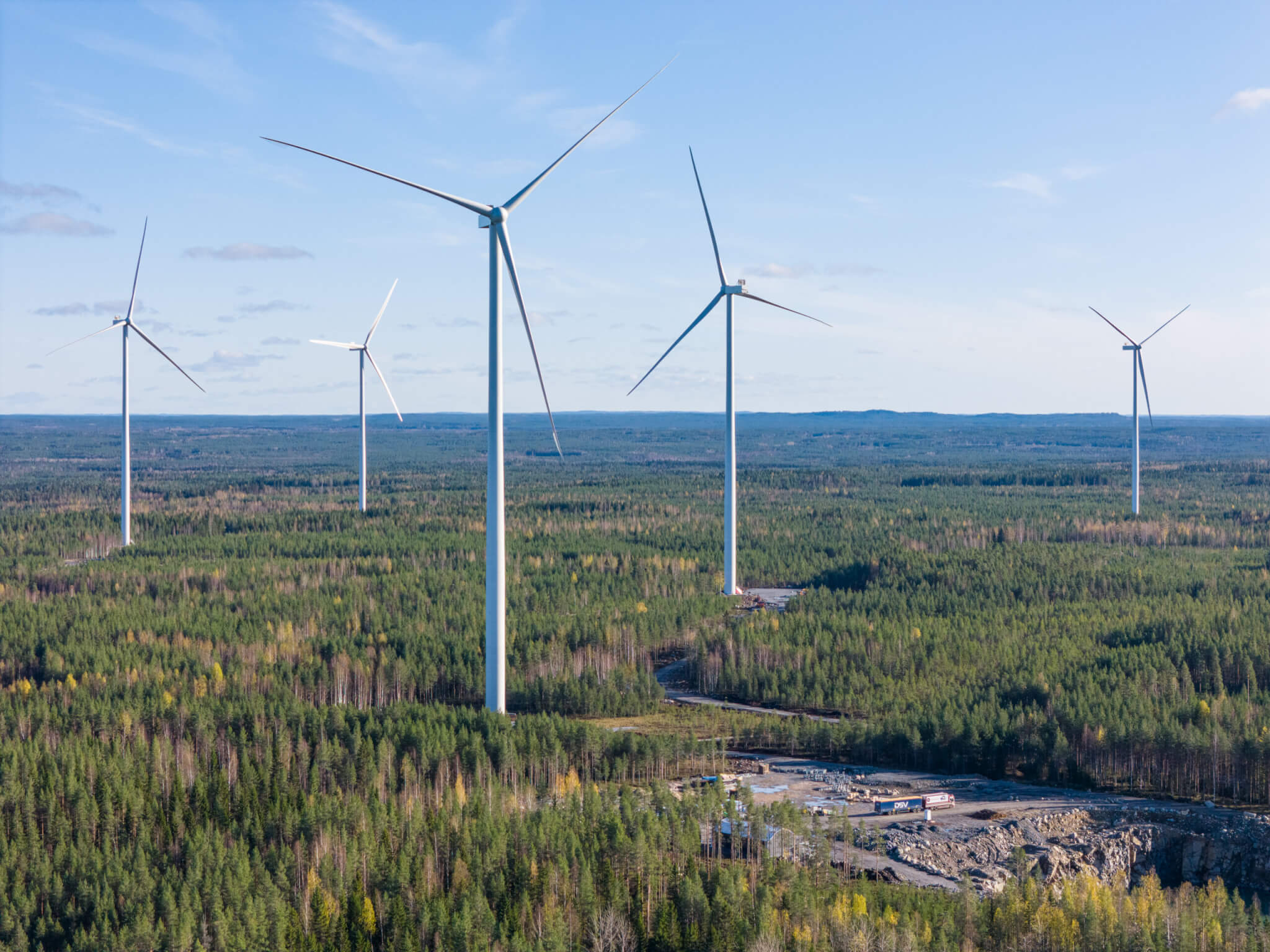
According to the Decision-Maker Barometer published by Renewables Finland, a clear majority of politicians and public officials want to see more wind and solar power in Finland. In addition to positive climate impacts and emissions reductions, the key benefits of renewable energy are seen to include strengthening Finland’s security of supply and energy self-sufficiency, enabling industrial investment and ensuring affordable electricity.
According to a survey of politicians and public officials conducted by Aula Research in summer 2026, there is strong support for increasing renewable electricity generation. Of all respondents, 75% want to see more utility-scale wind power and 89% more utility-scale solar power.
Positive climate impacts and emissions reductions emerged this year as the most important societal benefit of wind and solar power. In last year’s Decision-Maker Barometer, they ranked second. This year, 77% of respondents consider the climate impacts and emissions reductions of wind power important or very important, while the corresponding figure for solar power is 83%. The next most important societal benefits are considered to be the contributions of wind and solar power to security and security of supply, as well as regional vitality.
The key security benefits of renewable electricity identified by respondents are strengthening security of supply through distributed energy generation (73%) and increasing energy self-sufficiency through domestic energy production (71%). The most important economic benefits are enabling industrial investment in Finland (69%), ensuring affordable electricity (66%) and creating jobs across Finland (54%).
“It is an important signal that decision-makers recognise the climate benefits of renewable energy so strongly. At the same time, renewable energy is seen as a way to strengthen Finland’s energy self-sufficiency, electricity supply, security of supply and economy. As electricity demand grows, it is essential that Finland can produce enough electricity domestically, emission-free and at a competitive price. Building wind and solar power is not only about energy production – it is also about Finland’s future competitiveness,” says Anni Mikkonen, CEO of Renewables Finland.
Local decision-making strengthens project acceptance
According to the respondents, the acceptance of wind and solar power projects is strengthened when decisions on issues such as land-use planning are made locally by municipalities. 71% consider local decision-making an important way to increase project acceptance. Other important factors include active engagement with local residents and other stakeholders (52%), benefits to the national economy (50%) and property tax revenues received by municipalities (48%).
All forms of energy production also have negative impacts. In renewable energy projects, respondents particularly identify impacts on nature and landscapes, as well as issues related to the electricity system. For wind power, the most commonly mentioned concerns were biodiversity loss and forest loss (36%), as well as landscape and noise impacts (33%). For solar power, the main concerns were variability in generation, the need for balancing power and fluctuations in electricity prices (23%), followed by environmental impacts, biodiversity loss and forest loss (19%).
Read the results of the 2026 Decision-Maker Barometer (in Finnish)
Aula Research conducted Renewables Finland’s Decision-Maker and Media Barometer in summer 2026. The survey is a repeat study and was previously conducted in 2025 and 2024. A total of 224 national-level decision-makers and influencers responded to the survey.
*Translated with AI*
More information